

A payout error is not a math slip. It's a trust problem. When an agency sends the wrong figure, the creator notices immediately, and rebuilding that confidence takes far longer than fixing a spreadsheet.
Here's the direct sequence: confirm the earnings period first, start from net earnings (not gross, unless your agreement defines the split on gross), apply the agreed contract split, subtract deductions like chargebacks or refunds, and total what remains. Run these five steps in this order every time (unless your contract specifies a different treatment of deductions), and the math stays defensible and the creator stays paid correctly each cycle.
This guide walks through that sequence as a clear, repeatable process, with a full worked example so you can verify your own numbers against a clean model. We'll also flag the mistakes that most often throw payouts off, because nearly every dispute traces back to one of a handful of predictable errors.
What You Need Before You Calculate
Before touching a calculator, gather five inputs. Miss one, and you're guessing rather than calculating.
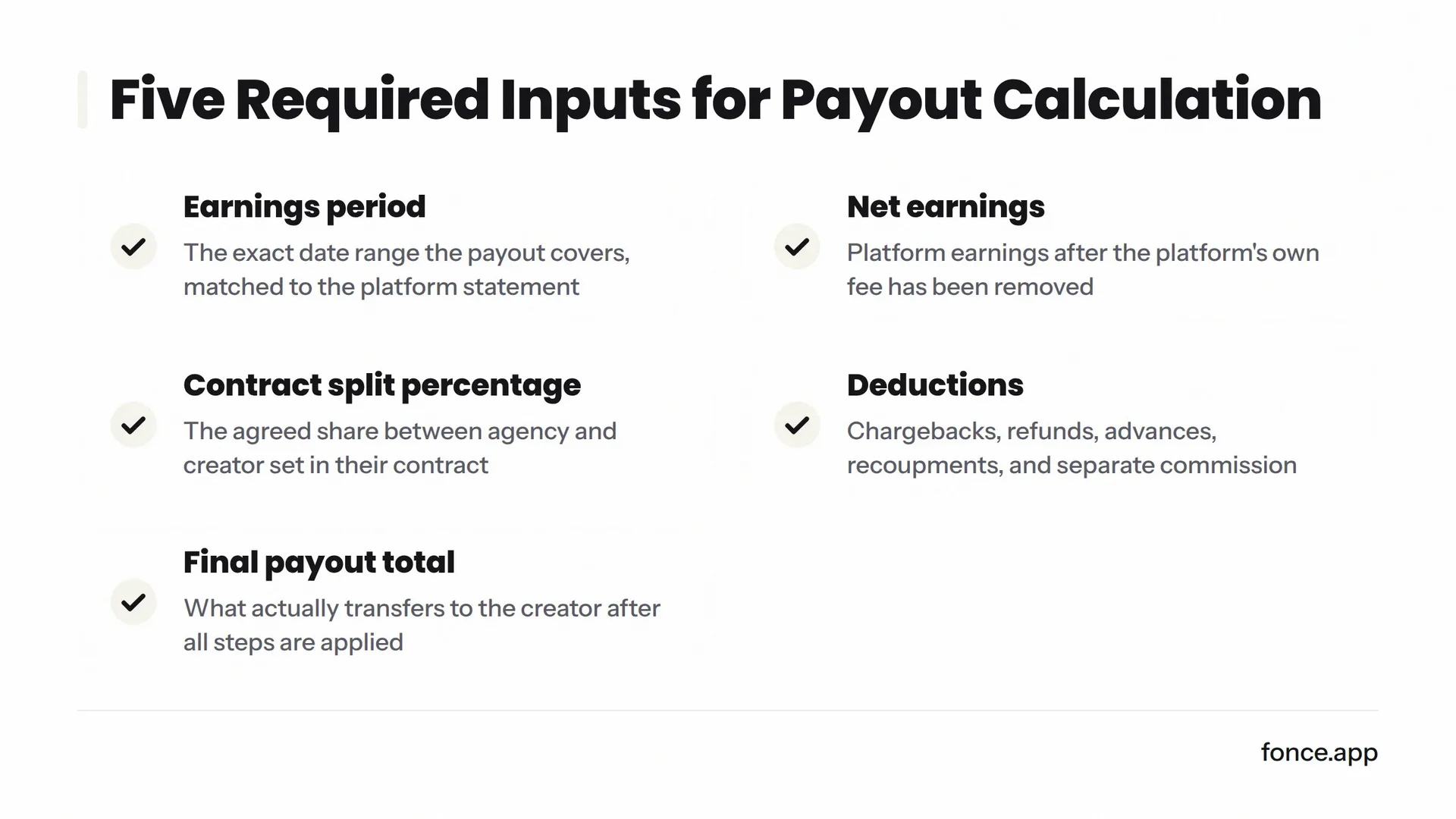
The Five Required Inputs
| Input | What it means |
|---|---|
| Earnings period | The exact date range the payout covers, matched to the platform statement |
| Net earnings | Platform earnings after the platform's own fee has been removed |
| Contract split percentage | The agreed share between agency and creator as set in their contract |
| Deductions | Chargebacks, refunds, advances/recoupments, and any separate agency commission |
| Final payout total | What actually transfers to the creator once all steps above are applied |
A quick note on terminology, since these terms get mixed up constantly:
- Earnings period: the specific window of time a payout statement covers (weekly, biweekly, monthly).
- Net earnings: what remains after the platform fee has already been deducted.
- Gross earnings: the full amount the platform reports before any fee is subtracted.
- Contract split percentage: the agreed division of net earnings between agency and creator, written into the management agreement.
- Deductions: amounts typically subtracted after the split, unless the contract specifies otherwise (chargebacks, refunds, advances, recoupments, or a separate agency commission).
Payout calculation is a workflow, not a one-off problem. That's why tools like FONCÉ App exist in the first place: these inputs need to live somewhere consistent, not scattered across screenshots and spreadsheet tabs.
Step 1: Lock Down the Earnings Period
Every payout calculation starts with the same question: what exact date range does this payout cover? Not "this month" loosely, but the specific start and end timestamps that match the platform's statement exactly.
This matters more than it sounds. Platform statements often report earnings in a different timezone than the one your agency uses. A creator's earnings for "Monday" on the platform's clock might straddle two days on your internal calendar, which shifts which transactions belong to which payout. We've written in detail about this exact problem in our piece on OnlyFans earnings and the gap between Eastern time and UTC statements, and it's worth reading before you lock in a payout schedule.
If your payout cycle is weekly, biweekly, or monthly, that cycle needs to line up exactly with the statement period you're pulling numbers from. This step comes first because every number that follows (net earnings, the split, deductions) is only correct if pulled from the right window. Get the period wrong, and you're calculating an entirely different payout than intended.
Step 2: Start From Net Figures, Not Gross
Once the period is locked, pull the net earnings figure for that period. Not gross, unless the agreement defines the split on gross.
This is the single most common entry point for payout errors. Gross earnings include money the platform takes as its own fee before a single dollar reaches the agency or creator. If you apply a net-based contract split to the gross figure instead of net, you're splitting revenue that was never actually available to split. The creator ends up either overpaid in a way that creates a shortfall later, or the agency absorbs a cost it never agreed to.
The platform fee itself - the cut the platform retains before anything happens - is already baked into the difference between gross and net. Our guide on gross versus net creator earnings breaks down exactly how that fee gets applied and how to spot it on a statement. For this guide, the operating rule is simple: net earnings are the starting point for a payout calculation, unless the agreement defines the split on gross.
Step 3: Apply the Contract Split
With a confirmed net figure in hand, multiply it by the split percentage set out in the creator's management agreement. This is the share arrangement between agency and creator, agreed in writing before any money changes hands.
Split structures vary by agency, by contract, and sometimes by creator tier. What matters for the calculation itself is the mechanical step: multiply the net earnings figure by the creator's agreed share. If you want the full picture of how agencies typically structure revenue splits, tiers, and negotiation patterns, that's a deeper topic covered elsewhere. For context on how contract terms like the split get documented, our post on contracts with a receipt walks through the agreement side.
Hold onto this: the split applies to net earnings (not gross, unless the agreement defines the split on gross), and, unless the contract specifies otherwise, not after deductions have already been subtracted. That second part trips up more finance teams than expected, which is exactly what the next step covers.
Step 4: Apply Deductions
Deductions typically come after the split, not before, unless the contract specifies otherwise. This is where chargebacks, refunds, advances, and any separate agency commission get subtracted from the creator's split amount to arrive at what's actually owed.
Chargebacks: A chargeback happens when a subscriber disputes a charge with their card issuer and the payment reverses. That reversed amount comes out of the payout because the money counted as earnings never actually settled.
Refunds: A refund is similar in effect but different in cause. The platform or agency voluntarily returns money to a fan, often for customer service. Refunds reduce the payout the same way chargebacks do, and both should be logged consistently, in the period your contract and the platform statement use.
Advances or Recoupments: An advance is money paid to a creator ahead of earnings, often to smooth a slow period or fund a campaign. A recoupment is the agency clawing that advance back once real earnings arrive. If a creator received an advance earlier, the recoupment amount gets deducted from the current payout until fully repaid.
Agency Commission: Some agency structures separate their commission from the contract split entirely, charging it as a separate line item. Where that's the case, it belongs here in the deductions step, applied after the split and alongside chargebacks, refunds, and recoupments.
Here's what genuinely changes outcomes: applying deductions before the split instead of after produces a different final number. If you subtract a chargeback from the full net earnings before splitting, the agency and creator effectively share the cost according to the split ratio. If you subtract it after the split, from the creator's portion only, the creator bears that cost alone. Which approach is correct depends on what the contract says, but the two methods are not interchangeable. Mixing them up mid-cycle is one of the fastest ways to create a payout dispute. The sequence has to be consistent and it has to match the agreement, every single time.
Step 5: Total the Final Payout
Once the split has been applied and every deduction logged, the final payout is simply what remains: net earnings multiplied by the split, minus chargebacks, minus refunds, minus any recoupment, minus separate commission if applicable.
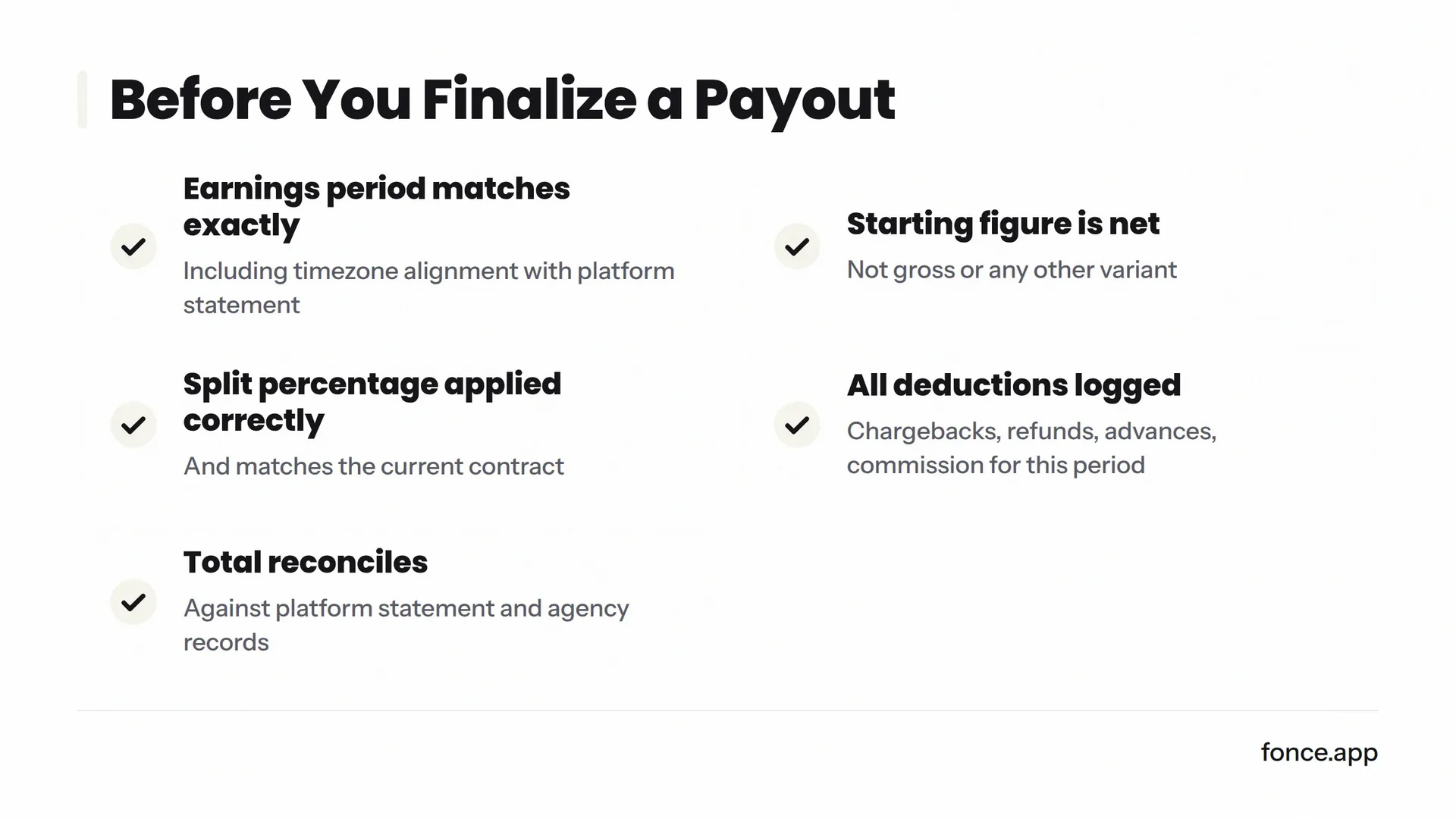
Before that number goes near a bank transfer, run it through this checklist. It's a checklist worth running on every payout cycle.
Before You Finalize a Payout
- Confirm the earnings period matches the platform statement exactly, including timezone
- Confirm the starting figure is net earnings, not gross (unless the agreement says otherwise)
- Confirm the split percentage was applied correctly and matches the current contract
- Confirm every deduction (chargebacks, refunds, advances, commission) has been logged for this period
- Confirm the total reconciles against the platform statement and the agency's own records
If any one of those checks fails, stop and fix it before the payout goes out. A number that "looks about right" is not the same as a number that reconciles.
Worked Example: Creator Payout Calculation
Let's run real illustrative numbers through the full sequence. These figures are for demonstration only.
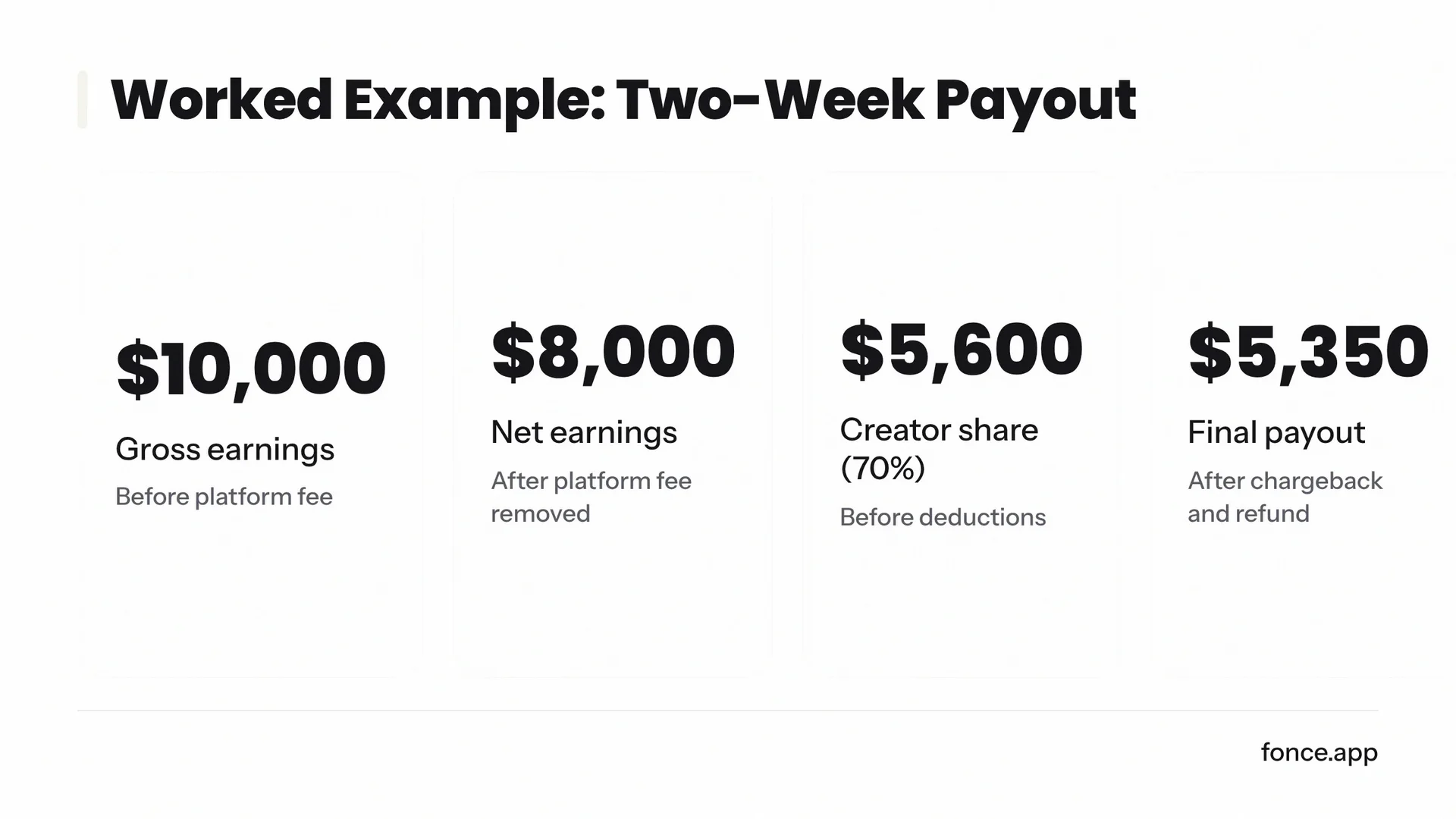
Say a creator's platform statement for a two-week period shows $10,000 in gross earnings. The platform's fee reduces that to $8,000 in net earnings. The creator's contract split is 70% to the creator. During that same period, there was one chargeback of $150 and one refund of $100.
| Line item | Amount |
|---|---|
| Earnings period | Two-week cycle, matched to platform statement |
| Gross earnings | $10,000 |
| Net earnings (after platform fee) | $8,000 |
| Split applied (70% to creator) | $5,600 |
| Deduction: chargeback | -$150 |
| Deduction: refund | -$100 |
| Final payout | $5,350 |
Walking through it: we start from the $8,000 net figure, not the $10,000 gross figure. We apply the 70% split to that net number, which gives $5,600 as the creator's share before deductions. Then we subtract the $150 chargeback and $100 refund, both of which happened within the confirmed earnings period, leaving a final payout of $5,350.
Notice what would happen if someone split the gross figure instead: 70% of $10,000 is $7,000, a number that's $1,400 higher than the correct $5,600 creator share before deductions are even applied. That's the kind of error that looks like generosity until it creates a real shortfall for the agency a few cycles later.
Common Mistakes That Break the Calculation
Most payout errors aren't exotic. They're the same handful of mistakes repeating across different agencies and creators.
- Splitting gross when the contract defines the split on net: applying the contract percentage before the platform fee has been removed, inflating the creator's apparent share.
- Applying deductions before the split: when the contract specifies deductions come from the creator's portion, subtracting them earlier changes who actually absorbs the cost.
- Mismatched earnings periods: pulling a statement for one date range but calculating against a different payout cycle, often caused by timezone differences.
- Missing chargebacks or refunds: forgetting to log a reversal that happened late in the period, so it never makes it into that cycle's total.
- Forgetting advances or recoupments: paying a full split without clawing back a prior advance, which pushes the problem into a later, messier cycle.
Before a payout goes out, ask three questions. Does the period match the statement exactly? Did the split apply to net, not gross (unless the agreement says otherwise)? Is every deduction from this period actually logged? If the answer to all three is yes, the number is ready to send.
Related Resources
This guide stays narrow on purpose: it covers the calculation sequence itself, not everything adjacent to it. A few related topics are worth knowing exist, even though they're covered in full elsewhere:
- Payroll software that automates the period-to-payout sequence instead of running it manually in spreadsheets
- Gross versus net creator earnings, for the full mechanics of how platform fees get applied
- How agencies structure revenue splits, covering tier structures and negotiation patterns
- A payout statement to send creators, covering what a clear, creator-facing breakdown should include
- Resolving payout disputes, for when a creator questions a figure and the calculation needs to be walked back and verified
- A creator payout sheet template, for teams that want a standardized worksheet rather than rebuilding the calculation each cycle
If you're running payouts for more than a handful of creators, doing this math by hand in a spreadsheet works until it doesn't. That's the point where agencies start looking at dedicated creator payroll tooling. For a related financial calculation that agency operators often run alongside payouts, our guide on agency profit margin formulas covers the margin side of the same business.
FAQ
How do you calculate a creator's payout from platform earnings?
Confirm the earnings period, start from net earnings rather than gross (unless the agreement says otherwise), apply the agreed contract split, subtract deductions like chargebacks and refunds, and total what remains. That five-step sequence, run in the order your contract specifies, is the calculation.
What is an earnings period in creator payout calculation?
An earnings period is the specific date range a payout covers (weekly, biweekly, or monthly), matched exactly to the platform statement it's drawn from, including timezone.
Why do you start from net earnings instead of gross earnings?
Because gross earnings include the platform's own fee, money that was never actually available to split. Unless the agreement defines the split on gross, starting from net ensures the split applies only to what the agency and creator actually received.
What is a contract split percentage and how is it applied?
It's the agreed division of net earnings between an agency and a creator, set out in their management agreement, applied by multiplying net earnings by the creator's agreed share.
What counts as a deduction in a creator payout?
Deductions typically include chargebacks, refunds, advances or recoupments, and sometimes a separate agency commission line, typically all subtracted after the split has been applied, unless the contract specifies otherwise.
Does the order you apply the split and deductions change the final payout?
Yes. Applying deductions before the split shares that cost between agency and creator according to the split ratio, while applying deductions after the split means the creator's portion alone absorbs the cost. The two methods produce different numbers.
What's an example of a full creator payout calculation from start to finish?
Starting from $8,000 in net earnings with a 70% split gives $5,600 before deductions. Subtracting a $150 chargeback and $100 refund brings the final payout to $5,350.
What are the most common mistakes when calculating a creator payout?
Splitting gross when the contract specifies net, applying deductions in an order that doesn't match the contract, mismatched earnings periods, missing chargebacks or refunds, and forgetting advances or recoupments are the five most frequent errors.
How does creator payroll software help with payout calculations?
It automates the period-to-total sequence, pulling the right net figures, applying the correct split, and logging deductions consistently, which reduces the manual errors that come from spreadsheet-based calculation.
What should an agency do if a payout calculation doesn't reconcile?
Stop before sending the payout and re-check each of the five steps: period match, net starting figure, split accuracy, deduction completeness, and the final total against the platform statement, correcting whichever step introduced the mismatch.
Running a clean payout calculation every cycle isn't about being a math expert. It's about following the same five steps every cycle, in the order your contract specifies, so the number you send is one you can defend if anyone asks how you got there. Get the sequence right, and the rest is arithmetic.